Sunday, 21 May 2023

Martin Amis (1949-2023)


My heroes were very much his heroes. Bellow, Nabokov, Hitchens. Except that he, too, was my hero.

I believe that we all have a writer who writes specifically for us. A writer whose every line we have to read, and internalise, and interpret. A writer whose every line we selfishly believe that only we can truly internalise, and interpret. For me, such writer was Martin Amis. 

While I had no idea that he had cancer (incidentally, it was the same cancer that Christopher Hitchens had), I approached his last book, Inside Story (2020), with a certain trepidation. It was, all things considered, a very strange novel. A little all over the place and a little unfocused, Inside Story felt like a final statement. It was semi-autobiographical, and not unlike something Konstantin Paustovsky once did, but it had the disturbing sense of life and fiction getting into each other's way. 'Why was it written?' was a question posed by many critics who reviewed Inside Story. Critics who may have forgotten that you never, ever, ask such a thing. That these four words are at worst poisonous and at best completely meaningless. Because once you get rid of this silly old question, you find all the wit and all the heart which you have always seen in his books. 

Martin Amis was (oh how wrong this 'was' feels) like an intimate friend. A literary lover, if you will. There are lines that got burned into me ("You always write for someone. Mother. Friend. Shakespeare. God".), and there are circumstances I will never forget. I remember how I was reading London Fields (for me, his greatest work) at five in the morning, inside a car in Brompton, following a rainy festival night. Or the dry summer day when the sun was killing me in a scorched park in late August as I was reading the grossly underappreciated The Pregnant Widow. Or, indeed the old yellow armchair in an apartment in Warsaw that saw me trudge along, quizzically, through the complex world of Inside Story. No, I do not profess that I loved his every book (Yellow Dog was, I believe, an artistic failure), but even his minor works (like the short story collection Heavy Water, or one of those slim early novels like Other People) were brutally witty, and incisive, and deliciously well-written. 

Obviously and somewhat inevitably, I was thinking of him on the day that he died - without me even considering for a second that he could die, or fall ill, or be 73 (after all, he was always the younger Amis). First, I was thinking of him because the new film based on his Auschwitz-set novel The Zone Of Interest was lauded at this year's Cannes. And this, one has to understand, after decades of cinematic flops and failures by directors who could never really perceive that Amis's books were essentially unfilmable. Second, earlier that day I was talking to someone about Martin Amis being a great, and rare, example of an artist escaping the shadow of a hugely successful parent.

And then he died, months after his friend Salman Rushdie had survived a brutal attack in New York. It was, of course, a literary life well lived. Amis himself had recently said in an interview that at the age of 25 he would never have believed that he would accomplish so much. But he did. He wrote close to three dozen books of fiction and non-fiction, and he had long become a much better writer than his father. Unwittingly, he also gave some of the best literary advice I have ever received. The best being perhaps "Never write a sentence that absolutely anyone can write". Someone has once asked me about the meaning of this particular advice as it appeared bizarre and not entirely meaningful. After all, how could one ever only write unique sentences? However, that was missing the point entirely. The point being that while writing, you always have to keep them in mind, those words: "Never write a sentence that absolutely anyone can write". If you do that, you will never once write a generic sentence. 

Last autumn, in Amsterdam, I went into an old bookshop to get a few books. However, the shop was closing and I only had ten minutes to browse, to make an agonisingly difficult choice, and to pay to an old man who pretended to have read every single book that he was selling. I was in full panic mode as I grabbed Julian Barnes's A History of the World in 10½ Chapters from a cluttered shelf and headed for the counter. On my way, however, I caught a glimpse of The Rub of Time, Amis's last work of non-fiction collecting his essays and articles from 1986 to 2016. It was a fortunate moment, a moment of incidental miracle, and I felt positively ecstatic as I left the bookshop and walked down the busy street of German tourists and Dutch cyclists. 

Today, when I come to terms with the death of Martin Amis, I find it hard to experience anything resembling that feeling. There is, nevertheless, something precious ahead of me, something that contains a tingle of that literary ecstasy. And that is me reading The Rub of Time in the coming days. Because I have not done it yet, and those pages hold the biggest promise.  


Thursday, 18 May 2023

My Cultural Highlights: BLEU COLLAPSE by Johnny Tchekhova


In a way, there is nothing as wrong as reviewing a work by someone you know. First of all, you will not like it. Secondly, you will be insincere and say many things you do not actually believe. And yet here I am, writing about the latest LP by Johnny Tchekhova (an odd sounding moniker of the French musician Grégory Peltier whom I have the pleasure to know personally). My single excuse, and you have to agree it is a rather good one, is that I actually love this album.

Grégory Peltier used to be in a Strasbourg-based band called A Second of June who played the sort of post-punk music that veered from shoegaze to dream-pop to synth-pop with relative ease. Later, Grégory released the patchy but entertaining Loubok in 2019 (as Johnny Tchekhova), and now, four years later, there is the new album titled Bleu Collapse (official release is tomorrow). Only this time, Johnny Tchekhova is actually a full band with other members contributing both musically and instrumentally. But getting back to the main question of whether Bleu Collapse is actually any good... well, I heard the record back in March, and I still remember how the initial sense of trepidation went away fifteen seconds into "Eaux rouges". 

To me, this is Grégory's most focused album yet. The same elements that have defined his music up until this moment (synth-pop, shoegaze, dream pop) are still in place, only this time nothing sticks out and the experience is pleasingly homogenous. After the smooth, dreamy opener, we get to the first true highlight which is the vaguely menacing "Nos vies d'ailleurs" that sounds not unlike Cocteau Twins in their supreme 80s form. The effective "Dépossession" (distinguished by a stellar guitar break at the end) is followed by the slightly Eastern-tinged bass riff of "Toxycontine" that swirls and dances before transitioning to the frankly masterful chorus.

So far so good. Then, after a laid-back dream-pop instrumental, we bump into the undisputed high point of the album, the intense and intensely catchy "Ceci n'est pas une chanson française" where, quite simply, everything works. The softly pounding drums, the timeless vocal melodies, the seemingly inconspicuous synths. The vocal hook at the end of the 'Les sentiers battus mille fois...' line is inspired, and overall it is hard for me to imagine someone hearing this song and not being caught up in all its infectiousness. I am also partial to the two long-winding but quietly eventful songs that finish the album - the title song in particular has a beautiful build-up and one the LP's strongest choruses.

What distinguishes Johnny Tchekhova from many bands doing this kind of dreamy post-punk is that the songs actually feel eventful and substantial. They grow and develop. They evolve. And Bleu Collapse may well be Grégory Peltier's best work to date. The album is a focused, concerted effort that leaves the taste of a sweet explosion. I would say the sound of the album mirrors the colour of the album's cover. Only it is a deeper and a much more intense blue. The collapse is glorious, too, and stays with you long after the album stops playing. 


Sunday, 14 May 2023

Three films. Beasts, Close, One Fine Morning.


These three films from 2022 are united by the French language. In The Beasts, it is a language that exists alongside Galician and Spanish. In Close, it is occasionally interrupted by Dutch. In One Fine Morning, it is pretty much the only thing that you hear. I am not going to say that French is what makes these films great - but I am not avert to that idea, either. These is some of the best cinema of 2022. 


The Beasts (2022)


God what a chilling, nerve-wrecking experience this film is. The Beasts is what you would call a countryside thriller. A middle-aged French couple moves to a village in Galicia to grow and sell eco-friendly vegetables. They used to live in France (Antoine is a former teacher) but they are now seeking to be close to nature and to lead a simpler life. If that sounds idyllic, wait till you start watching this film. The Beasts thrives on tension.

The problem is that the local people are not exactly happy to see the intruders. Two brothers in particular take active dislike to Antoine due to the fact that the latter blocked the deal involving the sale of land to a wind farm (the deal would prove lucrative to the few village inhabitants). Things turn from tense to downright ugly with inevitability and in disgusting slow-motion. There is vague abuse, there are direct insults. There are scenes in the local bar where the atmosphere could be sliced with a knife. At some point, Antoine and his wife discover that their tomato harvest has been spoiled. From that point on, Antoine takes a camera and starts shooting the abuse he is getting from the brothers and showing the videos to local police who remain passive and largely disinterested.

The tension just builds and builds until you can barely take it anymore. And yet, oddly, you cannot look away. The film is harrowing, hypnotic, and utterly compelling. The fact that it is loosely based on real events is frankly disconcerting.


Close (2022)


If Quiet Girl was my favourite coming-of-age film of 2022 (if not, in fact, my favourite film of 2022), then Close takes the second place. When it comes to portraying teenage friendship and pressures of growing up, the film gets so many things right that I felt a personal connection. Even the details; when the boys are playacting an attack from an imaginary army of brutal enemies, it takes me back a million years.

The two boys are Léo and Rémi, and they are friends. Close, intimate friends. They playact, they run through gorgeous flower fields in rural Belgium, they daydream and they even sleep together in the same bed. However, a moment comes (and it is usually but a moment) when things begin to change. A girl at school asks them a question: are you together, like, are you a couple? There is a barely perceptible ripple in the air ("No, of course, not!"), and a few awkward silences, and then a small rupture appears. The rupture grows in size, and then all of a sudden Léo wants to take up ice hockey and what is the point of riding to school together, anyway? It is all very uncomfortable, and heartbreaking, and all of sudden there is something terrible you will have to live with for the rest of your life.   

Close is also a very beautiful film. The aforementioned fields of Belgian flowers are breathtaking, but even they are merely a backdrop to the simple story that contains a bitter lesson. Ironically, it is a lesson you cannot really learn before the bell actually rings. 


One Fine Morning (2022)


Mia Hansen-Løve is hailed a genius by a great many credible film critics. To my shame, One Fine Morning was my first film by this French director, and I had clearly been missing out. I watched it late at night in a small hotel room, and it has stayed with me ever since. This is sensitive, sensual, powerful cinema.

The ever brilliant Léa Seydoux plays Sandra, a young widowed woman whose life is both hectic and incredibly stressful. She works as an interpreter and a translator (which is symbolic in the context of the film), she has to raise a daughter, her ageing father is suffering from neurodegenerative disease and her personal life is at worst nonexistent and at best deeply troublesome. The events are mostly centred around Sandra's father (formerly a renowned philosophy teacher) who keeps forgetting things and is in urgent need of a nursing home (distant echoes of Amour and The Father - but the film has a distinct voice of its own). Again, it is a simple story that contains lots of subtlety and substance (as well as a great deal of sex). To me, the film has many profound things to say about the interplay between reality, wishful thinking and pretence. And all that against the ravishing views of Paris (the film ends with a striking scene by the Basilica of Sacré-Cœur) and a song by Bill Fay.

One Fine Morning (actually a reference to the title of a possible biography by Sandra's father) is simply great French cinema. It is full of beautiful, complex characters who could speak about politics in a taxi car in a way that is no less stylish and alluring than a visit to the Musée d'Orsay.


Sunday, 7 May 2023

Альбом. "DiP" (2009) / Port Mone.


Адразу ж адзначу, што я не збіраюся пісаць адны толькі хвалебныя артыкулы пра сучаснае беларускае мастацтва. Зусім не - а інакш не было б сэнсу пачынаць гэты праект. Інакш не было б сэнсу ў мастацтве, а таксама ў разнастайнасці пачуццяў, якія яно выклікае ў чалавека. Але ж нешта ўтрымлівае мяне ад крытыкі, і я адцягваю, зноў і зноў. 

Я належу да таго постсавецкага пакалення, для якога не існуе нічога больш сумнага, чым гук акардэона. Акардэон - гэта змрок і ўпадніцтва, туга і смутак. Я памятаю, як ён гучаў на вясковых святах, калі надыходзілі прыцемкі, і нехта выягваў аднекуль гэтую жахлівую зялёную махіну з бясконцымі клавішамі і кнопчакамі і пачынаў іграць. І хацелася выць ад безнадзейнасці і адчаю. Я добра памятаю таго мужчыну сталога ўзросту, што іграў на акардэоне каля Камароўскага рынку ў Менску. Кожны раз, калі я чуў яго, настрой імгненна псаваўся - прычым не так ужо важна, іграў ён нешта сумнае ці вясёлае. Акардэон рашуча адхіляў любую надзею... Хіба што на альбомах Тома Уэйтса ён не даводзіў мяне да думак пра самагубства. 

І тым не менш, акардэон займае цэнтральнае месца ў гучанні менскага інструментальнага трыа Port Mone. Менавіта яго чуеш, калі ўключаеш альбом. Гэты напружаны пераліў акардэона, які чамусьці так моцна нагадвае таемны гук аргану... DiP - дэбютная пласцінка гурта, якая выйшла ў 2009 годзе. Шмат хто аддасць перавагу другому альбому (Thou, 2014), які стаў калісьці сапраўднай падзеяй у беларускай музыцы. Шматлікія прызы і прэміі, а таксама званне лепшага беларускага альбома дзесцігоддзя. І ўсё ж, нягледзячы на захопленую крытыку і мае добрыя пачуцці да Thou, менавіта Dip падаецца мне самай разнастайнай, самай эмацыянальна насычанай працай гурта.

Першае, што хацелася б адзначыць: я не пішу пра добра беларускае мастацтва. То бок, мяне не вельмі цікавіць мастацтва, якое можна лічыць добрым для Беларусі. Так наогул нельга ставіць пытанне. Мастацтва можа быць добрым ці не - незалежна ад краін ды кантынентаў. Дык вось - Port Mone ствараюць выдатную музыку. Але музыку, якая паходзіць з Беларусі. 

Галоўнае, што ёсць у DiP - гэта інтрыга і прыгажосць. Прычым прыгажосць тая не падаецца ані правільнай, ані банальнай. Яна часта складаная, неспадзяваная, нават балючая. Заўсёды глыбокая, заўсёды інтрыгуючая. Кожная кампазіцыя на альбоме рухаецца і струменіцца (нездарама альбом цалкам прысвечаны воднай тэме - дарэчы, некалі тое хацеў зрабіць Міхал Анемпадыстаў, але не паспеў), кожная мае вялікую ўнутраную моц. Усё развіваецца, нічога не паспявае надакучыць (самая доўгае кампазіцыя на альбоме доўжыцца чатыры хвіліны). Ёсць тут пэўная містыка ("Tuna"), ёсць чароўны мінімалізм ("Catfish"), ёсць сапраўдныя выбухі інтэнсіўнасці ("Crossing"). Месцамі DiP нагадвае ECM джаз, але ж заўсёды акардэон надае некую рамантыку. І ўжо тая вяртае мяне дамоў.

Port Mone запісалі не так шмат студыйнай музыкі. Усяго толькі два альбомы (тры, калі ўлічваць суменсы праект з ДахаБраха). Але гэта толькі яшчэ адна падстава ў чарговы раз услухацца ў меладычныя, сканцэтраваныя парывы гэтага альбома. Які, імаверна, мог бы стаць добрым саундтрэкам для якой-небудзь атмасфернай еўрапейскай стужцы, але які наўрад ці будзе прыдатным альбомам для фонавага праслухоўвання. Гучанне занадта вынаходніцкае і інтрыгуючае, каб не аддаць яму ўвесь свой час. І потым гэты кляты акардэон... Здаецца, я пачынаю любіць яго. Ёсць моманты, калі ён вяртае мяне назад, у мінулае, але гучыць ён неяк па-іншаму. Больш стыльна, з большай глыбінёй і, можа, нават з надзеяй. 


Sunday, 30 April 2023

Album of the Month: HOUSE OF ALL by House of All


When it comes to writing reviews, I do not have too many rules that I have to follow. I do not let bad production overshadow the quality of songwriting, and there is no particular number of listens that I need to give to an album to be able to make a more or less objective assessment (could sometimes be one but could often be seven). Still, there are two things which seem important to me. First, each work of art should be treated on its own terms. Second, and I know how controversial this is going to sound, a good album is a good album.

Which is all to say - I do not give a damn what Mark E. Smith's sisters think. And I most certainly do not care whether fans of The Fall find the release of this album offensive or in bad taste. The Fall could well be my favourite band of all time, and I am not offended that five of its former members decided to record a new album of original music. 

The said members were all part of The Fall at various points of the band's extensive run. Still, it is the presence of Steve Hanley that made me excited in the first place. Not just because Steve Hanley wrote what I consider to be one of the two or three greatest rock autobiographies of all time (The Big Midweek: Life Inside The Fall really is as good as all that), but because for decades (decades are centuries in The Fall) his bass guitar defined the sound of Mark E. Smith's band. As a matter of fact, Smith knew this better than anyone and up until the final break-up in the late 90s kept asking Hanley to come back. 

And now Steve Hanley's bass is all over House of All, along with Pete Greenway's sharp guitar lines, pounding drums courtesy of Paul Hanley and Simon Wolstencroft as well as the distinctive voice of Martin Bramah. The musicianship here is terrific, and while the influence of The Fall is transparent (obliquely charismatic lyrics, repetitive grooves, spoken word singing), none of it sounds like a parody. Quite simply, the five men spent too much time in that brilliant and deranged institution (The Fall) to be left unscarred. So the influence is there, the effects are palpable, but in the end it is all about the songs. And the songs are excellent. 

As soon as I hear the powerful bassline at the beginning of "Ayenbite", I know I am not going to be disappointed. All they need to do is to settle into a good groove, and they do that effortlessly. After the pleasantly wistful "But Wilful I Am", we arrive at the magnetic minimalism of "Dominus Ruinea" and the enigmatic and ominous-sounding "Harlequin Duke" (I have to say: that title does remind me of Genesis). The second side opens with the classic repetitive pop of "Magic Sound" (whose chorus will stay with you for days), then continues with the beautifully titled "Minerva Disrobed" which is propelled by a classic guitar groove coupled with a memorable keyboard line. After the relentless "There's More", we finish with the ageless pop-rocker "Turning Of The Years" which could well be my favourite song on the album.

There is a lot of personality in these songs, and personality is not something you can get cheap. They just have it. I do not view this album as disrespectful or unnecessary - I view it as a great collection of songs from five musicians who have something to say. That this 'something' happens to be 'a lot', is hardly surprising. Having said that, the "Harlequin Duke" bassline alone is worth the admission price. And yes, I do hope there is more. 


Rating: ★★★★


April Round-Up


In a somewhat shocking twist of events, Matt Berninger's solo album from 2020 (Serpentine Prison) has become a very special record for me. Shocking, because I had spent a big part of my life convinced that The National is one of the least interesting bands in the world. Judging by their latest, however, I was right all along. First Two Pages of Frankenstein (★★★) is sort of well-written and sort of crushingly boring. The usual stories of melancholy and heartache sugar-coated in vaguely catchy melodies. Side A is mostly good, side B is inoffensive in a bad way. 

I did not care for Jethro Tull's latest comeback, RökFlöte (★★★), either. Again, there is nothing bad about any of it, and Ian Anderson can still play the flute and the acoustic melodies do come through on occasion, but the urgency of The Zealot Gene is all gone. For die-hard fans only (which, I guess, covers Jethro Tull's entire fanbase). 

The most anticipated comeback, however, was that of Patrick Wolf. There was a certain period in my life when I was downright obsessed with Patrick Wolf's music, and his sudden disappearance following the unabashedly poppy album Lupercalia and the compilation Sundark and Riverlight was both inexplicable and frustrating. Now that some of those internal demons have been apprehended, there is a new EP titled The Night Safari (★★★½). It is slightly meandering in places, but the magic is definitely there. Patrick's voice retains that mixture of romance and intensity, and the melodies are still intriguing. The cleverly arranged "Nowhere Game" and the pleasingly optimistic "Enter The Day" are the standouts, and ultimately it is like these ten years never even happened. 

Another excellent EP was released by Gabi Garbutt. The Creation of Birds (★★★½) opens with the somewhat misleading collaboration with Du Blonde, the upbeat and timeless lead-off single "Panic", and then settles into a much more introspective set of songs. Thankfully, her midtempo material is beautiful indie rock with personality. Which is not something I have managed to discern in the critically acclaimed Blondshell album (★★★). I admire the brevity, some of these songs are fairly well-written ("Olympus" is undeniable - and reminds me a little of Sheryl Crow at her 90s best), and the guitar sounds wonderful throughout, but I have not discovered too many reasons to care. 

But I do absolutely care for Tiny Ruins' new album, Celebration (★★★★). Masterful songwriting from New Zealand, with beautiful instrumentation and a voice that has depth and incredible youthful elegance. Celebration effortlessly sets itself apart from a million indie-folk bands by being so beautifully out of time. There is charisma in each guitar lick and vocal undertone. 

It is hard to say if many people still care, but The Damned have just released their best album in nearly four decades. Darkadelic (★★★½) is a bit of a mess, but this is entertaining, professional mess. The Damned play tough punk rock diluted by psychedelic pop and gothic leanings. They also have a tendency to break a song up in the middle and go for circus laughter or rumble of thunder, and I have always had a soft spot for a middle eight (however bizarre this middle eight may be). 

There is a certain point at which the magic of Susanne Sundfør's new album started to get through to me. It was the piano part of the wondrous "Rūnā" followed by the blissful angelic humming and singing. Obviously it is not the only highlight here ("Alyosha" is gorgeous beyond reason), but if there is anything wrong with Blómi (★★★½), it is that the sense of catharsis is not permanent. Which can be a little frustrating. All the same, an album to rediscover and get lost in. Norwegian soundscapes, conventional beauty, avant-garde spoken word piece in German, heavenly voice and even a bizarre Ramones reference. The rating is largely immaterial - what I know for certain at the moment is that the cover is stunning. 


Songs of the Month:


Susanne Sundfør - "Alyosha"

House Of All - "Turning Of The Years"

PJ Harvey - "A Child's Question, August"

Tiny Ruins - "The Crab / Waterbaby"

Patrick Wolf - "Enter The Day"

The Damned - "You're Gonna Realise"

Bloodshell - "Olympus"


Saturday, 22 April 2023

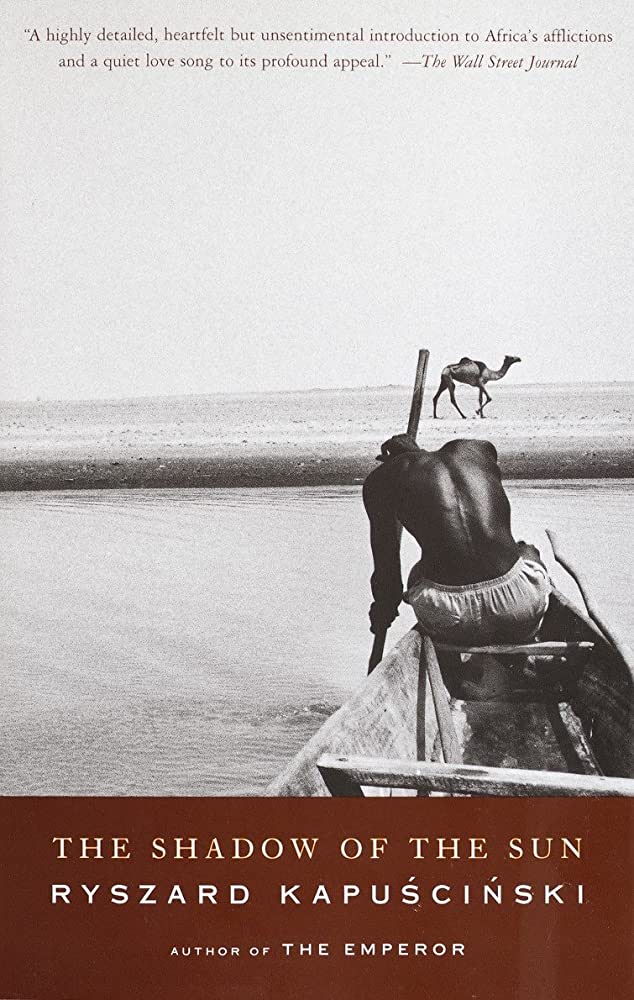
Polish Diary. "The Shadow Of The Sun" by Ryszard Kapuściński.


Like Sergiusz Piasecki, Ferdynand Ruszczyc and many others, Ryszard Kapuściński is one of those prominent Poles whose Belarusian roots are largely disregarded. However, while Piasecki favoured Belarusian settings for his criminal shenanigans of the 20s and Ruszczyc grew up and came of age in Minsk, Kapuściński's association with Belarus is nebulous in the extreme. What is there, really? A school, a two-storied building in Pinsk (which was a Polish city back in the 30s) and little else. Still, there was an odd satisfaction in the fact that my very first book by this great author and journalist was a Belarusian edition. 

The book, Black Tree ("Чорнае дрэва"), is a translation of the 1998 collection of essays titled The Shadow Of The Sun: My African Life. As is seen from the title, the book deals with Kapuściński's extensive experience of Africa from 1950s onwards. Some of the most exciting, violent and transformative decades in that continent's history when countries like Uganda, Eritrea, Rwanda and many others were ravaged by civil wars, bloodthirsty warlords and violent struggles for independence. Horrible, horrifying times - and yet these were the times that begged for the best journalists and reporters. One of those reporters was, of course, Ryszard Kapuściński who found himself at the very heart of African revolution. Kapuściński was a little known Polish journalist back then who really wanted to be inside that particular coalmine. In one of the very first stories here Kapuściński, poor but well-connected, is someone who belongs. A person who is willing to do anything to get onto a plane that will take him to another hot spot.

It is important to note that hot spots are, indeed, hot. Literally hot. Scorching hot, sizzling, blood-meltingly hot. In Africa, Kapuściński writes, you are constantly "moving towards the sun". "Heat stops blood-flow". "Human life relies on shade". These are just a few descriptions of what it feels like to be in an African town, the sort of place that should make people in Kapuściński's homeland happy that Polish weather can be so gruesome and so full of rain.

Kapuściński knows Africa, he understands it - and in order to get to the bottom of the continent and its people (inasmuch as that is actually possible), he never shies away from living in the poorest district (in a decrepit apartment which is constantly robbed), from eating with locals (which involves sitting in a circle in a shady room and eating rice with your bare hands), from taking treacherous journeys across the desert (which could easily result in sudden death from dehydration). He goes for the heart of Africa, and Africa pays him back. In these pages, you can actually witness Kapuściński's evolution as one of the all-time great reporters. His eye for the detail is astonishing, his storytelling is hair-raising. When he writes that "the trembling of malaria-stricken bodies was the only movement in the street", he horrifies and transfixes you. 

He goes for the heart of Africa, and Africa reveals its visceral self. In these twenty-nine essays, sketches, lectures, articles, reports, Kapuściński presents a three-dimensional image of the continent in all its true essence. Heat, malaria, thirst, snakes, crime, poverty - but also people whose primordial depth and intense simplicity are equally shocking and fascinating. Once again, Kapuściński gets really close to them as he discovers their complex religiosity and their peculiar sense of time (which is a lot more adventurous than whatever comes out of our watches and clocks). He untangles, or at the very least tries to, the complexities of the obscene ethnocides in Rwanda, and he explains how a simple hole in the ground could become a new hub of life. There are dozens of stories here, and every single one of them is worth hearing. 

The Shadow Of The Sun is, essentially, great literature. One could treat these essays as short stories, and they will work on that level as well. There is brilliant symbolism here (the black tree being the essential one), there is great tension (the fight with cobra is worthy of any thriller), masterful descriptions (Kapuściński truly captures the briskness of African sunset) and there is the ultimate deus ex machina at the very end of the book. When the elephant appears and scares everyone around, some see the animal as merely an elephant and some, well... there are those who see it as something a lot bigger than that.