Showing posts with label Poland. Show all posts

Sunday, 26 April 2026

Marlon Magnée in Warsaw, 21.04


You have to give it to them - Poles have a sense of humour. As a sweaty, exhausted Marlon Magnée finishes doing "Elle ne t'aime pas" (which is the song that once started my love for La Femme), he turns to the audience. "Guys, could you recommend the best bar in Warsaw? One I should go to while I'm in the city?"

"Rusałka!" is the loudest scream. 

"Okay", he says. "I will go there". 

Oh dear. I hope he googles the place before he does. But then he probably won't remember the name once the concert is over and he is done with the extended encore that includes a few classics like "Sur la planche 2013" and "Tatiana".

Incidentally, Rusałka (Polish for mermaid) is a good title for a new La Femme song. It is also a cult bar młeczny, an old-school cafeteria-like eatery with traditional food, low prices and the sort of decor that will transport you back into communism in no time at all. And the exterior? Let's just say if Marlon does remember the name of the place, he won't dare to go in. 

And yet it is hard to imagine the district of Praga without this place. Just as it is hard to imagine it without the cozy little yard off 11 Listopada St. that includes a mural titled "You Will Never Be Younger Than Now", a nostalgia vintage shop, an atmospheric bar with strong Twin Peaks vibes and the bizarrely named club called Hydrozagadka. The latter is the perfect venue for a Marlon Magnée concert. The demented, dilapidated streets of Praga-Północ with a Soviet-looking milk bar called Rusałka in close vicinity. The intriguing late-night thrill of the little yard. The weed-smelling little club with a small stage but a lot of attitude. Really, you wouldn't want to see Marlon Magnée in another setting.

The warm-up act is a pleasantly eccentric Polish band called BEMY with a singer who looks like a wild version of Bill Evans and a bunch of highly entertaining songs in French. The performance is full of brilliant energy and a brief setlist full of Zbigniew Wodecki's repertoire adapted for a small club in Warsaw.

After which comes Marlon Magnée, and we start with the single "Plus fort que toi" off his excellent solo album Dark Star (released earlier this year). After a few lethargic La Femme records, it is a real return to form, and the energy exuded by the visibly pumped Magnée proves that he, too, knows that. He then does "La fureur d'Annie" followed by the slower, classic-sounding "La première", and quite soon it becomes clear that he is doing Dark Star in its entirety. The songs feel as good as they are on the record, if not better. I would probably welcome some more variety (the club ambience is relentless and intense), but I'm still caught up in all this high-octane, motorik-imbued nonsense. 

The audience are into it, too, and alongside the beer-wielding, weed-smoking teenagers there are also people of older age and even a couple of random French people who are visibly happy to see their compatriot in this wild, dark heart of Varsovie (speaking of which, Marlon gets into the habit of saying dziękuję after each song he does). Not to jump or at least sway like a madman is nearly impossible, and I don't think I have experienced anything quite like this since the good old days of The Menzingers blowing the roof off a small club in Dublin ten or twelve years ago.

The beautiful respite comes by way of the self-penned timeless gospel tune "Cause There Is No Time" that brings the concert proper to its stylish end. Except there is also an extended encore, and Marlon is clearly thrilled to do more songs. "Are you ready for "Tatiana"?" he asks after a brief pause. And oh God yes we are. Then another song. And then, after the last goodbye, he does two more. He doesn't want to leave, and neither do we. And no - he won't be going to Rusałka tonight. Polish milk bars close at 5 pm. 


Tuesday, 9 December 2025

Film review: ANNIVERSARY by Jan Komasa


Jan Komasa really took a gamble here. Anniversary is his first film released outside Poland, and for his English-language debut he chose to go all in. Well, maybe not all in, but it certainly takes guts to exploit the current state of American society with a political psychodrama. Audacious would be an understatement. 

The film got little to no promotion from Lionsgate studios which feared Anniversary would prove too controversial. This is sad for two reasons. First, the film is likely to end up being a box office flop. Secondly, it is a really powerful cinematic experience, one that will haunt you long after the end credits.

It will not flop in Poland, however. Polish people love their heroes, and a relatively young filmmaker doing it in the US (and Great Britain, too; Komasa's second film, The Good Boy, is coming out in 2026) will not go unnoticed. The cinema hall in Wroclaw where I watched it a little while ago was anything but empty. The audience was buzzing excitedly at the start of the screening, and left limping and downtrodden, haunted and traumatised. It is that kind of film.

And yet it is exactly what you would expect from Jan Komasa. If you have seen Hater or Corpus Christi, you have to realise that the bleakness will be gripping and the smiles will be compromised. Gripping is the word here. For all its darkness and ever-impending gloom, Anniversary is extremely watchable. Partly this is due to exemplary acting (Diane Lane, Kyle Chandler, Dylan O'Brien, Phoebe Dynevor - they all excel) and partly due to the meticulous, smart direction. 

Oddly, the trailer almost makes it seem like a horror film - but it isn't, or at the very least the horror is manifested in a different way. We start with a close-up of Elizabeth Nettles, a young woman who is about to be introduced to her boyfriend's parents at their 25th anniversary party. She is carefully practicing exactly what she is about to say. Because there is a past: she used to be a student of her boyfriend's mother, a radical one, with some hair-raising views of democracy. What soon transpires is that she has actually written a book about the future of America, and the cult following soon becomes reality. The whole thing unfolds in a gradual but totally relentless way. Like a heavy train that just won't stop. It is a chilling, absolutely brutal experience. But God you cannot look away. 

Anniversary tackles a lot of things, and some could say that it tries to handle way too much for a film under 120 minutes. There is a difficult question of modern-day academia. Conformism. Democracy. US politics. Family dynamics (there is a particular Thanksgiving Party scene that is some of the tensest and unbearable filmmaking I have seen in a while). However, I would argue that the film deals with all of those issues quite well, and manages to weave them all into one coherent narrative. The most common issue raised by American critics is that the film does not take sides. Which is interesting. Not in the sense that it does actually take sides (it does not), but in the sense that it is viewed as a flaw (and this, I believe, is where we come to the very line that separates Hollywood from European cinema).

There is no moment of respite here, though, not for one second. It is just this one ruthless onslaught, and maybe I do miss a little humour (I don't mean jokes), a little heart - sometimes Anniversary may feel a little too slick and calculated, a little too perfectly conceived and executed. After the first fifteen minutes of the film, the only genuine smile you see in the film comes from Josh (Dylan O'Brien), Elizabeth's boyfriend and future husband. But it is the kind of smile that will fry your nerves and fill you with utter hate. 

P.S. Also, just for the record, "Don't Dream It's Over" truly is one of the finest pop songs ever written.


Thursday, 17 July 2025

"ЦЯГНІК ДА ПОЗНАНЯ"


Зусім хутка выходзіць мая другая кніга, "Цягнік да Познаня". Гэта пяцьдзесят польскіх партрэтаў, гісторый, эсэ. Месца дзеяння ўвесь час мяняецца, але рэдка выходзіць за межы Польшчы. Прынамсі, геаграфічна. 

Гэта вельмі эмігранцкая, вельмі асабістая кніга, дзе з дробных эпізодаў і маленькіх дэталяў я паспрабаваў стварыць свет рэальных людзей. Бо я сапраўды сустракаў кожнага з іх. Польскую піяністку, якая ў старым памяшканні грала музыку Баха. Хлопчыка, які апантана чытаў кнігу на бруднай падлозе варшаўскага аўтобуса. Маладую дзяўчыну, якая стаяла на каленях у касцёле св. Роха ў Беластоку.

"Цягнік да Познаня" перамог у літаратурным конкурсе "Шуфлядка" ў намінацыі "нон-фікшн". Перадзамову кнігі можна зрабіць на сайце выдавецтва Gutenberghttps://gutenbergpublisher.eu/shop/ciahnik/  

У продажы яна з'явіцца напрыканцы месяца. 26 ліпеня кніга будзе прадстаўлена на літаратурным фестывалі ў Кракаве.


Thursday, 7 December 2023

Polish notes (November '23)


Graveyards of Poland... While I may never again experience anything quite like the spiritual dread I felt at Krakow's Rakowicki cemetery earlier this year, Stare Powązki in Warsaw is the place to go to at the start of November. The old cemetery was established in 1790 and is home to over a million graves (Krzysztof Kieślowski, Anna Bilińska and Chopin's parents are all buried here). It is a cold autumn evening with countless lanterns giving off warmth and red light. Everyone around is looking for a grave or talking about the dead, and even small kids are carrying flowers. A young violinist is playing Polonez Ogińskiego and there is a great sense of solemn beauty and calm about the place. The lanterns smell of wax and warm lemon, and I see people walking slowly through The Avenue of the Distinguished as well as the dimmest and the narrowest of alleys. It is essential to be here on the first of November to start to understand these people... Truly there is nothing like All Saints' Day in Poland. 

In the second half of November, there was a two-day art exhibition at Hali EXPO XXI. Warszawskie Targi Sztuki. Not simply an art exhibition but also a sale. Over a hundred art galleries from all over the country brought their best paintings in order to sell them at an attractive price (not too attractive, as we soon find out). There is a lot of diversity ranging from grotesque modern art to Polish classics to a huge area taken up by wooden statues that all resemble Alberto Giacometti. It was a great experience - mostly, though, I'm left with an image of an elderly man in a vintage green coat whispering to his wife as we walk past them: "Nie wiem, nie wiem...".

No one goes through life unscathed, and I guess this is my turn. The central Warsaw Urząd in Marszałkowska is not a welcoming place and yet you have to be here to have any chance at all, to prove something, to make a stand. The place is full of people in long gray coats, and they invariably resemble a famous Japanese anime character in an impenetrable white mask. Only there are lots of them here, and they all sit on chairs or stand along the walls - with lowered eyes, sucked in by the bureaucratic vortex, waiting for their number. At some point, there is a sound, unpleasant but oddly inspiring in the given circumstances, a number appears on the screen and another figure pulls their head out of the invisible hood, awkwardly pushes the chair they were sitting on, takes off the white mask and runs to their window. At the window, it could mean a failure or a happy end. Mostly, though, it means nothing. 

It was something of an odd experience - to be seeing the 50th movie by Woody Allen in French (the original language of the film) with Polish subtitles. But there is a true sense of event, not least because this is likely to be his final work. It is a fine little film, a cross between Scoop and Match Point, and its existence might have been predicted by the final scene of Hollywood Ending. There are not too many people in the cinema, so thankfully no one will find out that my French is even worse than my Polish. 

I love Polish trams, and when I build my route around Warsaw, I often neglect subway and buses. Somehow, trams seem to be the way to go around the city. There are many interesting characters here who demand to be written about, and you can often see them in one of the four incarnations of Warsaw trams. The modern ones, smooth and slick, that you want to be on when you are late. The older ones, divided into two parts, that have a slight whiff of Soviet past. The very old ones, with uncomfortable plastic seats, that you hop on when you do not care too much about your destination. And, finally, the ancient ones, the ones that only appear on holidays and with a steering mechanism that, miraculously, does not transport you to the start of the 20th century.


Monday, 6 November 2023

Polish notes (September-October '23)


There is a place in Warsaw that genuinely scares me. It is located behind Ujazdowski park, between the Embassy of France and the Embassy of Germany. It is not even a place, really, just a spot. An object. An installation. A telephone booth. It is white in colour and in order to reach it you need to walk on the wooden footpath platform that leads you over the green lawn. The actual door to the booth is quite rigid and it takes an effort to get it open. Once inside, there is a heavy thud and an odd feeling of anxiety that intensifies as you pick up the receiver and hear the whooshing sound of wind. Then you notice a memorial book, and some strange dots of instinct and imagination start to connect. I have once dreamed this place up, I have seen it in several of my nightmares. The idea comes from Japan, from a man who had built a phone booth just like that in order to talk to his dead cousin. It is with a heavy heart that I put down the receiver and leave the telephone booth. Not because there is no one. But, rather, because there are too many, and the wind is not loud enough.

In Mochnackiego St., in the centre of Old Ochota, lies the best cafe in Warsaw. It is called La Buvette and it was opened a few years ago by a French immigrant from Alsace. The man looks like a less glamorous Johnny Depp and you can often see him in the cafe cutting bread or talking to someone about Strasbourg. The menu is brief but to the point: French wine, warm tartines (for which we are willing to come every day), cheese, baguettes and ham. The place offers authentic snails and even desserts, but that is not why you are here in late September. You come because the evenings are already cool, but you still want to sit on the small terrace surrounded by historical architecture of Kolonia Lubeckiego. Because all you want to do in autumn is to defy autumn. La Buvette is one of the best kept secrets of Warsaw, and the ideal place to do it.  

Saska Kępa is special. While I will never prefer it to Kolonia Lubeckiego, it is an absolute thrill to come here on a warm Sunday in early October. Interestingly, there is little to no striking architecture here. As you walk away from the National Stadium and Rondo Washyngtona and enter Francuska St. with its small cafes, hanging umbrellas and broad terraces, you notice square-shaped houses that strongly resemble one another. They should look dull but they don't. Infused with the bohemian past of the area, they appear substantial rather than bland. Besides, there is a man nearby carrying a huge painting. A plaque with the name of a local artist. Two young men shooting black and white photos. There are streets stretching in different directions away from Francuska St., and they reveal local wonders. Saska Kępa looks like a world unto itself - but a generous world, ready to host you on any given Sunday in the middle of Indian Summer.

While I missed the Warsaw Film Festival due to a sudden vacation, there was still time for the ultimate cinema experience of watching the three and a half hours of Scorsese's latest film. Four, in fact, as apparently there is nothing that can make Polish cinemas cut back on trailers and advertisements. Still, the film could go on for a couple of more hours for all I care as the quiet acting of Lily Gladstone gripped me like nothing else in recent memory.  

On Halloween, there is a knock on the door, and it catches me off-guard. Because I am not thinking about the kids. I am not thinking about anything as I open the door and see the six of them - in elaborate make-up, dressed as witches. "Cukierek albo psikus!" And oh my God, I'm not prepared. I have nothing, and they are waiting with a sinister kind of patience. I tell them to hang on for a minute, return to the apartment and grope for cupboards seeking desperately - seeking anything that remotely resembles sweets. Nothing! Will apples do? Black tea? Avocado? In the end, there is a cautious sigh of relief as my fingers detect a cardboard box at the back of a top shelf. Belarusian sweets, two years old, abandoned and probably stale. But they are my only hope - and soon I reemerge from behind the door and hand them over to the little witches. There is an uncomfortable pause. Apparently, they had been expecting something else. Still, they take the box, mutter their collective gratitude and vanish on the dark landing. Halloween is big in Poland. I have to remember it next year.

The Central Station in Warsaw is a lonesome place. Or it can be when the evening settles down, crowds disappear and you wait for someone. My old professor of English Literature emerges from behind a faceless railway bakery and we embrace and try to cram a million words into a brief meeting. There is so much to say, in English, in Belarusian, in Russian and even in Polish, before his train to Poznań and before the station is switched off (because it has to be switched off, at some point), that we often say nothing. "Do not come back to Belarus", he insists before we say our goodbyes. "Do not even think about coming back". The Central Station, meanwhile, is empty but never entirely dark.


Friday, 8 September 2023

Polish notes (August '23)


As we drive into Łódź late in the evening, on a glum Sunday, Tricky starts playing one of his recent songs. "Take It There" is the perfect soundtrack for the city whose unnerving charm has long become legendary. And it is all true. All of it. The abandoned buildings with punctured eyes, the sinister looks of drunk teenagers, the trams that move in disgusting slow-motion, the dim Sunday shops that look permanently closed. "How far are we from the centre?" I ask a friend. The friend grins: "This is the centre". Indeed. Behind it all, however, there is a rich history of Polish film-making (Wajda, Munk, Kieslowski and Polanski all studied here) that barely even teases your senses. Increasingly, though, as we trudge through the twilight fog, I start to notice the small details: a girl in pink, a red glimmer in an abandoned window, a bizarre similarity between the main square and Piazza San Marco in Venice. The square in Łódź, however, is broken, dismantled, permanently taken apart. David Lynch's favourite city, no less.

Before Łódź, however, there is the OFF Festival in Katowice and a threat of rain. A resourceful young man at the entrance is shouting something about the quality of his ponchos and the impending showers. The ponchos, the young man insists through his roaring mouthpiece, could save our lives. Indeed: the forecast is implacable. Still, it does not prevent desperate festival-goers, Silesians and tourists alike, from getting in. The OFF Festival is one of the biggest festivals in Poland, and this year's line-up is a sizzling proposition. While I have not yet caught on to the brilliance of Jockstrap and King Krule, I am here for Spiritualized and Slowdive. And it is all worth it. The crowd is manageable, and the toilets do not make you lose hope in humanity. Most importantly, though, there is a lot of great music. Via electrifying American gospel, via Brazilian folk from Belarus, via The Strokes' Is This It performed in its entirety by a very capable Polish band, we will all get to see the pixie-like figure of Slowdive's Rachel Goswell who will be as amazed as everyone else: because it will be long after midnight, and the rain will not have started.

The sad thing about Belarusian Kupalauski Theatre is that they do not have a venue of their own. This time, in mid-August, they are performing in an experimental music theatre in the north of Warsaw. Worse, the said theatre is located inside a shopping mall, by a local multiplex cinema. Do we really care, though, as we walk through a very long hall and enter a rather small room filled to the brim with people who look intelligent, hungry and somewhat ill at ease (among them: artists, journalists, book publishers, politicians). We are all here to see the new stage production by this great theatre-in-exile: "Geese-People-Swans" by Alhierd Baharevich. It is, in fact, an adaptation of the second part of Baharevich's celebrated novel Dogs of Europe, and they do it faithfully, with slight changes that seem warranted and to the point (the bizarre sci-fi ending, for instance, is all but gone; the tinkering with dates also works). As the actors walk on to the stage for the final bow, everyone in the room is in tears. Still hungry, still intelligent - but no longer ill at ease. 

The National Museum in Warsaw is currently holding an exhibition of art  which it has acquired over the last couple of years. The room that I am most interested in is, of course, the room with a dozen or so Marc Chagall's painting. This is actually my second time at the exhibition: I am starting to fall in love with Chagall as I get older. All of a sudden, I see great warmth in the colours and elaborate child-like lines. The highlight, to me, is My Life Between Vitebsk and Paris from 1954. In the center of the picture, in the hands of those unfading lovers of Chagall (one of whom has the eyes of the artist, inevitably), there is a bouquet of flowers dividing the canvas into two halves. Above, there is Paris with its breathtaking rooftops and the obligatory steel tower. Below, there is Vitebsk, which I have never been to, but which I recognise at a glance.

Bielany, while not exactly the most mind-blowing district in Warsaw, is still worth a visit. Old Bielany in particular has two streets that are among my favourite places in the city: Płatnicza and Kleczewska. Quaint old architecture, cobblestoned road, gas lanterns, rose gardens and a bakery called Dej (one of the best in Warsaw). 


Monday, 7 August 2023

Polish notes (July '23)


On the way from Krakow to Auschwitz (which will always sound as 'Oswiencim' to my ears), the guide, a big and emotional Polish girl named Katarzyna, keeps asking trivia questions and talking about the economics and the eugenics of it. For the time being, we agree and we play along. After all, no amount of books, articles and films (no, not even my trip to Dachau a few years ago) can prepare me for what I am about to see. Because the scale is... well, there is no word in the English dictionary that could adequately explain the scale. 'Staggering' is nothing, and 'overwhelming' is weak. There is a point, after the stories of blood and guts and vomit scratched away from the floor of the gas chambers before a new group of prisoners is brought to the slaughter, when senses leave you and you look at the familiar trees and the mountains around the camp and you feel this is not just about the Jewish riches and the ethnic cleansing. This goes well beyond that, into the abyss that no one could ever explain, or even begin to make sense of... And the word? Well, perhaps 'unbearable' could do.   

Hučna Fest is now an annual event - a development which is both wonderful and rather tragic. Held between the Vistula and the ever magnificent garden on the roof of the Warsaw Library, it is an event for immigrants. Mostly, it attracted me due to the conversation with Alhierd Bacharevič. Not always eloquent (good writers do not have to be good speakers; as Nabokov once put it, "I think like a genius, write like a master, and speak like a child"), he was nonetheless quite animated this afternoon and read out expressively from his recent autobiography. Still, I come away with a book of poems by Ángela Espinoza Ruiz who signed my copy of her Belarusian poetry with a child's hand and a memorable line. A true poet, then. 

While I can take shopping malls in small doses, Stary Tarasy is the place in Warsaw I absolutely cannot stand. Literally everything about it deprives me of the will to live - the design of its roof, the wandering teens, the smell of Zara home, the inevitable fast food. Everything. And yet this was the place where I ended up watching Oppenheimer. The film is, of course, Chistopher Nolan at his overwhelming best, and a welcome return to form after the boring and impenetrable Tenet. For a short while (well, not too short, as the film lasts a whopping 3 hours), it seemed like I forgot all about the place where I was. And I am not too sure that Barbie would have done that. 

I have long realised that going to Żoliborz is almost like going to a different town. As you get off the tram soon after Warszawa Gdańska, on Adama Mickiewicza street, you find yourself walking through a narrow park towards the Warsaw Citadel. It is a picturesque walk that culminates in an area that lives entirely in its own world. Old Żoliborz is one of the richest places in Warsaw and the part of it which is located between the circular square of Thomas Wilson and the snake-shaped alley of Andrzej Wojciechowski, houses a luxurious private sector with grape-covered balconies and stone sculptures in carved patios. In the summer, the sector looks especially attractive and blinds you with its lush greenery. Local residents can often be found in a Spanish wine bar nearby (WineTu), where they blissfully chill on the midday terrace to the sounds of American jazz and the clinking of Sunday glasses. It is a different Universe, and inevitably, you want some of it. 

Finally, Krasiński Garden has to rank as one of the best parks in Warsaw. With its calm pond and the tasteful facade of the palace, it manages to be both striking a reserved, and steadies my nerves quite effortlessly as I hurry to Bonifraterska street for the wicked and cruel canal treatment. 


Saturday, 8 July 2023

Polish notes (June '23)


"SMELLS LIKE TEEN SPIRIT!!!"

These are the words shouted by someone in the Warsaw club Niebo during the Built To Spill gig at the end of June. Polish humour can be a force for good, and even the emotionless Doug Martsch bursts into a genuine smile... The concert is, of course, excellent, with just the right amount of melodies and guitar solos to keep things going. Yes, his voice is getting weaker now, and the setlist does not feature "Broken Chairs" (a crime, obviously), but when another member in the audience screams "You are my favourite Doug!", I find it difficult to disagree. Not with this version of the immortal "I Would Hurt A Fly".

Beer Station is the place in Warsaw to have a late-night political conversation about the current state of affairs across the Eastern border. Two former students took me to this Belarusian pub in Lwowska Street, and despite the godawful cocktail that almost made me lose faith in humanity (as well as in the future of this particular establishment), I found the experience strangely rewarding. It is, in the end, all about the conversations as well as a Belarusian musician named Takindang playing a charming little folk set late after dark. 

Jassmine is closing for the summer and Wojtek Mazolewski's electrifying gig was just about as fine a parting gift as we could get. It was a diverse set that veered from blues to rock to jazz to soul, and while not everything worked, the musicianship was astonishing. When the audience screamed (and they screamed a lot), you felt they were screaming your guts out. Which is to say, I see why he is so beloved here, in a country that has always valued taste and a sense of wild restraint.  

There are actually two Ochota theatres in Warsaw. One is called Och-Teatr and features a wonderful stage adaptation of "Who's Afraid Of Virginia Woolf?" in its extensive programme while the other one is actually called Ochota Teatr and is more of an intimate, left-field venue. Established shortly before the Second World War, it has been active for nearly 100 years now. Since it is only a couple of minutes from the place where I live, it was only a matter of time before I got to see their take on "A Streetcar Named Desire". And it was all I ever wanted from theatre: visceral, emotional, experimental and utterly gripping (my full review is here). After all, there was always a reason why Stella's husband was of Polish descent.  

Two girls are playing this irresistible literary game while sitting on the floor of an English bookstore in Puławska Street. The bookstore is called The Books (no points for originality), and the game is them picking up a random book and reading out the first and the last sentences. It is a great game, and I love hearing their laughter as I trudge through the wonderfully cramped space of my favourite bookstore in the city. There is a recent Rushdie, a forgotten Updike, a surprising Banville, and there is also your last chance ever to get into Neil Gaiman. 

Afterwards, step into the underrated Arkadia Park which manages to be both opulent and somewhat reticent. Find a bench by the water, and you might just see something that nobody else can see.  


Tuesday, 6 June 2023

Polish notes (April-May '23)


The viral video shot by an American tourist in Warsaw underground provided a striking image: rows upon rows of Polish commuters reading books. Poles really do read a lot, and, oddly enough, they mostly favour paper books. At the end of April, in Białystok, there was a book fair that impressed me with the sheer multitudes of kids begging their parents to buy them something to read. There is an old Polish gentleman buying Belarusian books in Białystok, there are scores of Polish teenagers with dramatic haircuts haunting the bookshelves at your nearest Empik. There is, too, a young man walking his dog in Sue Ryder Park with a large paper book firmly in his hand. He is actually walking his big Labrador - but he is not letting go of the fascinating plot.

The international book fair in Warsaw at the end of May is just as impressive - except that in Warsaw you tend to take everything for granted. It is supposed to be gargantuan and it just has to be held in and around the Palace of Culture and Science. I come soon after the opening, and the sheer scope of this thing is frankly bewildering. And just as ever, I become broke in a matter of seconds. Books have truly achieved a cult status in Poland. 

Jassmine is the jazz club of Poland. Coming here is just as essential (and, quite frankly, inevitable) as booking a table at Birdland in New York. Things happen here, and on May 7, Piotr Matusik Trio were playing music from the Independence LP (2020). While that album is excellent in its own right, their brand of ECM jazz thrives in a live setting. The concert was a blast from beginning to end, the solos were engaging, and the audience were transfixed. Much to the annoyance of the waiters who did not nearly get enough orders. My Old-Fashioned was all but forgotten on the little square table, behind my back, the moment that the 12-minute opener "Longing" started playing. A shame, because they make good cocktails at Jassmine.

It is always great to discover Belarusian places in Warsaw, and the best discovery since Culture Cafe (slightly overpraised, but still good) was a place called Soulmates hidden in the midst of the disturbingly enormous Marshal Edward Rydz-Śmigły Park. Located by a skate park and opened by people who used to own a Minsk establishment called Soul Kitchen (for the record, Soul Kitchen is a brilliant Warsaw restaurant), Soulmates specialises in pastry. I have been here five times now, and I have never left disappointed. And with a freewheeling terrace like that, how could they disappoint? Bonus points for offering some of the most adventurous herbal teas in the city. Truly a place to return to, unlike the country we have all escaped from.

Finally, it is wonderful news that they have now allowed dogs into Ujazdowski Park. High-brow and trim, it only had one thing keeping it from being my favourite park in Warsaw. A certain roughness, a certain spontaneity. Well, they certainly have that now. 


Saturday, 22 April 2023

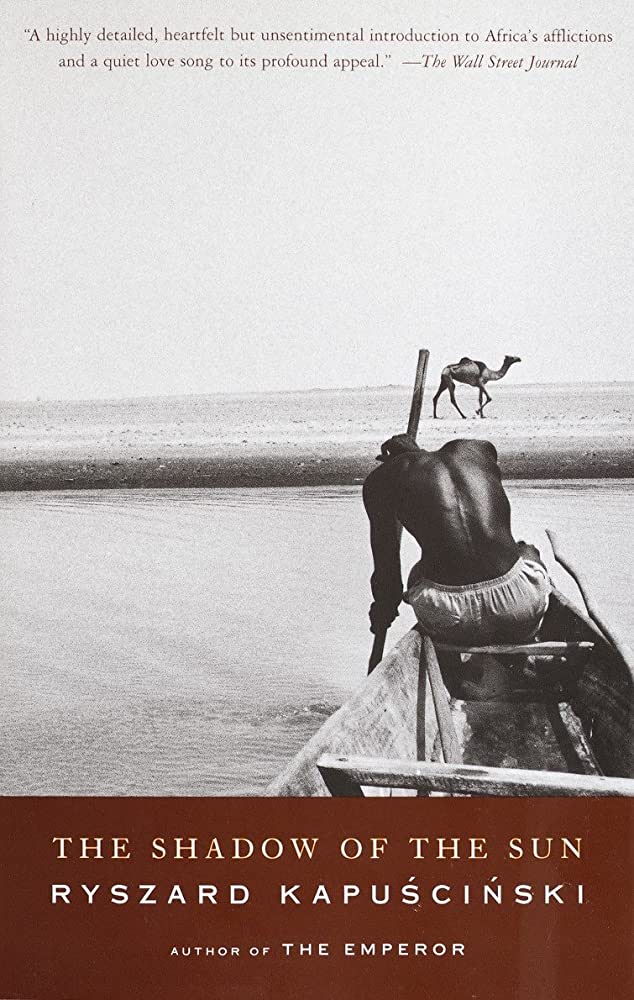
Polish Diary. "The Shadow Of The Sun" by Ryszard Kapuściński.


Like Sergiusz Piasecki, Ferdynand Ruszczyc and many others, Ryszard Kapuściński is one of those prominent Poles whose Belarusian roots are largely disregarded. However, while Piasecki favoured Belarusian settings for his criminal shenanigans of the 20s and Ruszczyc grew up and came of age in Minsk, Kapuściński's association with Belarus is nebulous in the extreme. What is there, really? A school, a two-storied building in Pinsk (which was a Polish city back in the 30s) and little else. Still, there was an odd satisfaction in the fact that my very first book by this great author and journalist was a Belarusian edition. 

The book, Black Tree ("Чорнае дрэва"), is a translation of the 1998 collection of essays titled The Shadow Of The Sun: My African Life. As is seen from the title, the book deals with Kapuściński's extensive experience of Africa from 1950s onwards. Some of the most exciting, violent and transformative decades in that continent's history when countries like Uganda, Eritrea, Rwanda and many others were ravaged by civil wars, bloodthirsty warlords and violent struggles for independence. Horrible, horrifying times - and yet these were the times that begged for the best journalists and reporters. One of those reporters was, of course, Ryszard Kapuściński who found himself at the very heart of African revolution. Kapuściński was a little known Polish journalist back then who really wanted to be inside that particular coalmine. In one of the very first stories here Kapuściński, poor but well-connected, is someone who belongs. A person who is willing to do anything to get onto a plane that will take him to another hot spot.

It is important to note that hot spots are, indeed, hot. Literally hot. Scorching hot, sizzling, blood-meltingly hot. In Africa, Kapuściński writes, you are constantly "moving towards the sun". "Heat stops blood-flow". "Human life relies on shade". These are just a few descriptions of what it feels like to be in an African town, the sort of place that should make people in Kapuściński's homeland happy that Polish weather can be so gruesome and so full of rain.

Kapuściński knows Africa, he understands it - and in order to get to the bottom of the continent and its people (inasmuch as that is actually possible), he never shies away from living in the poorest district (in a decrepit apartment which is constantly robbed), from eating with locals (which involves sitting in a circle in a shady room and eating rice with your bare hands), from taking treacherous journeys across the desert (which could easily result in sudden death from dehydration). He goes for the heart of Africa, and Africa pays him back. In these pages, you can actually witness Kapuściński's evolution as one of the all-time great reporters. His eye for the detail is astonishing, his storytelling is hair-raising. When he writes that "the trembling of malaria-stricken bodies was the only movement in the street", he horrifies and transfixes you. 

He goes for the heart of Africa, and Africa reveals its visceral self. In these twenty-nine essays, sketches, lectures, articles, reports, Kapuściński presents a three-dimensional image of the continent in all its true essence. Heat, malaria, thirst, snakes, crime, poverty - but also people whose primordial depth and intense simplicity are equally shocking and fascinating. Once again, Kapuściński gets really close to them as he discovers their complex religiosity and their peculiar sense of time (which is a lot more adventurous than whatever comes out of our watches and clocks). He untangles, or at the very least tries to, the complexities of the obscene ethnocides in Rwanda, and he explains how a simple hole in the ground could become a new hub of life. There are dozens of stories here, and every single one of them is worth hearing. 

The Shadow Of The Sun is, essentially, great literature. One could treat these essays as short stories, and they will work on that level as well. There is brilliant symbolism here (the black tree being the essential one), there is great tension (the fight with cobra is worthy of any thriller), masterful descriptions (Kapuściński truly captures the briskness of African sunset) and there is the ultimate deus ex machina at the very end of the book. When the elephant appears and scares everyone around, some see the animal as merely an elephant and some, well... there are those who see it as something a lot bigger than that. 


Friday, 17 March 2023

Polish Diary. "Who's Afraid Of Virginia Woolf?" at Teatr Polonia.


Somehow, the play Who's Afraid Of Virginia Woolf? has been a constant presence in my life. 

I watched it back when I was a kid, late at night, with my sister, when the adults were not at home. We watched the famous movie adaptation from 1966 starring Richard Burton and Elizabeth Taylor. I do not believe I understood it back then but it still had a profound effect on me - the kind that grips you and you cannot quite explain why. It felt funny and it felt tragic and then Elizabeth Taylor delivered those final words and I just wanted to become a playwright. 

Later, I read the play when I was twenty and bedridden in hospital. By then, the worst days were behind me and I needed to read something as part of my recuperation process. One of the books that I requested was, quite inexplicably, Edward Albee's Who's Afraid Of Virginia Woolf? It provided a lot of hysterical laughter but it also delivered a few hard-hitting blows that brought me ever closer to understanding the play.

Later still, I used it (along with Edward Albee's other famous piece, The Zoo Story) in my University thesis on effects of the Theatre of the Absurd. Here, I delved deep into the play and its two main protagonists and even the title that had always intrigued me to no end. 

And now, years later, I finally did it last night. I saw the stage adaptation of Who's Afraid Of Virginia Woolf? at Teatr Polonia in Warsaw. Needless to say, anything less than special would not have done it - and, thankfully, they did it justice. Which means it was very special indeed.


photo by Krzysztof Bieliński
                                  photo by Krzysztof Bieliński


Directed by Jacek Poniedziałek (he also translated the play into Polish) and starring Ewa Kasprzyk in the role of Martha, this turned out to be a very faithful rendition in a relatively small and intimate theatre packed to its absolute limit... And of course it only takes the main actress to say "What a dump!" at the beginning (in Polish, obviously), for Albee's play to get its claws into you. And all of a sudden, it is just as gripping as ever. Martha and George are a middle-aged couple who return home after a University party (George teaches at the History Department). They quarrel, they make jokes, they are tender and they are at each other's throats. Martha has invited a young couple to visit them later tonight, and this is were the story really takes off. From the very first moment, the young guests are hurled into the complex games of Martha and George's relationship. Games which are by turns entertaining and downright savage. 

The audience was very much alive, to a fault - but that is the sinister magic of Albee's play, that masterful interplay of humour and deadly seriousness. This interplay repeatedly catches the audience unawares, and time and time again the fallout of laughter gets in the way of another line that is absolutely devastating in its brutal and unforgiving gravity. These are awkward moments, but they were planted into the devious tapestry of the play from the very beginning. In a way, they are the whole point of what you are witnessing.

And they, too, are the trap (similar to the one that the young couple fall into, naively and continuously), for placing them alongside each other in such a rapid and incessant succession requires utmost concentration and taste on the part of the director and the cast. But even taking into account the degree of difficulty, the Polish adaptation is a great success and adds a new power and poignancy to Martha's affectionate monologue towards the end of the second act. This version was not perfect (none of them are), and the decorations seemed a little too faceless and unimaginative to my liking, and sometimes the 1966 film is conjured  followed too closely, but in the end - all my complaints fade away and cease to matter. Because each adaptation is different, and each throws a great surprise when you least expect it (the Pink Floyd song at the start of Act Two was not on the cards). Because, crucially, with every adaptation you get closer to the truth which is never too obvious and always elusive in the case of Albee's play. 

Needless to say, the performances were entirely in Polish and I would not have been as ecstatic had I not learned the play by heart ages ago. Some lines are hissed, some are whispered, and your grip on the language has to be sublime. Sadly, the two girls who were leaving the theatre behind me were not as fortunate. They were Americans, and they kept complaining about how they had not understood anything that was going on in the play. All that arguing, all those accusations... They kept bringing it up again and again, and at some point and in my mind their words and their questions started to string themselves together into the immortal catchphrase coined by Edward Albee. The one that is also the title of this classic play.


Wednesday, 14 December 2022

Polish Diary. "The Soil".


It is always wrong to reduce a whole museum to just one work of art. However, if I absolutely had to do it here, at the National Museum in Warsaw, I would go to Ferdynand Ruszczyc and his masterwork "The Soil". That is a painting of such internal power and primordial intensity that you have to make sure you take it all in slowly, calmly, getting lost in the rough textures of what you are seeing. Because it is not even about the details. This time, it is all about the sheer grandiosity of those horrifying clouds that the lonesome farmer is carrying on his shoulders. 

Oddly, I have always believed Ferdynand Ruszczyc to be a Belarusian painter. He was born in Belarus and died there (Bohdanow village in the Western part of the country), he spent his childhood in Minsk and he identified as Belarusian. However, Poland claims Ruszczyc as its own, even despite his early education in St. Petersburg as well as the fact that much of his life as an artist was spent in Vilnius. Having said that, the artist held Polish citizenship and it was in Poland that he got his recognition. To me, the point of the argument centres around the very painting. "The Soil". This bold, challenging work was rejected by St. Petersburg for its radical break with conventions but was accepted in Poland that immediately recognised "The Soil" for what it was: a masterpiece of impressionistic realism. That, as well as Ruszczyc's subsequent career in Poland, guarantees the rightfulness of Poland's claims. 

The National Museum in Warsaw displays great works of international, and internationally recognised, art. In its essence, however, it is a Polish museum. The first floor is devoted exclusively to religious paintings, icons, sculptures and installations, which subdues your spirit and sets the mood for the whole experience. And then, upstairs, Gustave Courbet and Paul Signac, while certainly good, do not really overshadow the works of Polish art. Alfred Kowalski's travelling stories of grim realism, Piotr Michałowski's striking portraits from the 19th century, Aleksander Gierymski's early impressionism... These are all works that give credibility to Polish art, which is precisely the point of any national museum.

Still, while I was impressed by the story behind Stanisław Wyspiański's creepy "The Mulchs" and the tasteful, slightly mysterious expressionism of Konrad Krzyżanowski, it is Ferdynand Ruszczyc and "The Soil" that have really stayed with me. I remember how once, in the National Gallery of Art in Washington DC, I spent an inordinate amount of time staring at "Woman with a Parasol" (which could qualify as my favourite painting of all time). Well, the National Museum of Warsaw gave me something similar in the sense that I could not look away from Ruszczyc's painting even as people were rushing by me and a group of Polish children were listening to a lecture behind my back. Monet's masterpiece is a work of ecstatic beauty and subtle impressionism, but this is something completely different. 

With "The Soil", it is the physical, physiological effect that absorbs you. The painting is huge, but that is the only way for it to exist (I am enclosing it here, but it has to be seen live). It is not that "The Soil" drags you into its frame - it is that the painting bursts out of it. And you feel small, and insignificant, and utterly gripped, and a tiny step closer to discovering what art really stands for.


Monday, 21 November 2022

Polish Diary. Warsaw Film Festival.


This year, The Warsaw Film Festival was more than its name would suggest. Alongside the main programme (which is in itself quite extensive) it incorporated what would have been The Odesa International Film Festival. The latter did not take place for obvious reasons and so this gesture from Poland was, again, timely and gracious. Interestingly, though, the first thing I noticed as I stepped into the cinema to attend my first screening, was that in comparison with Odesa's festival, the one in Warsaw just did not have the oomph. In Warsaw, this was yet another event, one of many. 

Obviously, there were dozens upon dozens of movies in Warsaw this October and going through all of them would be a task both tedious and impossible. Which is why I would like to focus on just three of them. The ones that have won nothing and yet the ones that seemed most enduring to me. I sincerely hope they will not be forgotten, as so many things are once a film festival is over.

The first work that really caught my attention was What Remains by the Chinese filmmaker Ran Huang. It is an unnerving Scandinavian film set in the 90s about a man, formerly a patient of a psychiatric hospital, who confesses to a number of shocking murders committed years ago. We then embark on a journey that unravels something deeply disturbing about all of its main characters (policeman, psychiatrist, the self-confessed criminal). There is not much humour in the film and even the little warmth that it has gets compromised in the end, but the lead performances are all amazing (Stellan Skarsgård is perfect here) and the questions the film poses are the kinds that matter. Like, do we really want to know? Because we probably don't. 

Then there was a Danish period drama called The Kiss that looked lavish and sumptuous but which made me leave the cinema with my mind and my mental state completely unsettled. The Kiss is about the days just prior to the start of the First World War and a young recruit (excellent but awkward) whose good deed towards a stranger ties him to a rich household with a beautiful but crippled girl. What ensues is a Mermaid-like story that is also a complete opposite to what a fairy tale should stand for. The film has wonderful Danish restraint and a lot to say about white lies and how important it is to listen to your heart. And, equally, about how important it is to not listen to it too much.

Finally, there was an evocative Latvian film called January about a young wannabe filmmaker / photographer who finds himself in the midst of a difficult relationship and his country fighting for its independence from the swiftly disintegrating Soviet Union. It is a great story, and the historical backdrop makes it all the more powerful (especially if you consider how cruelly history keeps repeating itself). Oddly, parts of the film are a little reminiscent of Jarmusch's Stranger Than Paradise (a comparison the film is fully aware of). The acting from the young cast is emotional and bruising, the symbolism is inescapable, and the ending straddled the fine line between devastation, beauty and hope.  

It is hard to shake off the feeling that The Warsaw Film Festival just does not have as much significance as the famed Gdynia event in September. The one that truly is the Polish Film Festival that matters. Still, you do not really go to all these screenings to be swept away by the dresses and the buzz and the statuettes. Predictably, you only come here for the movies, and there is no question that there were some shattering cinema experiences in Warsaw this October. Those hopeful, depressing scenes from the streets of Riga in particular will stay with me forever.


Thursday, 13 October 2022

Polish Diary. Купалаўцы ў Варшаве.


Я ішоў на варшаўскую прэм'еру Купалаўцаў з цяжкім пачуццём у сэрцы і адной толькі думкай: пазнаю ці не? Углядзеўшыся ў родныя твары, ці знайду Манаева, Белахвосцік, Гарбуза? Ці пазнаю? Ці ёсць там яны яшчэ? Ці не засталіся ў Кіеве? Ці не з'ехалі ў Канаду? Справа ў тым, што я не бачыў іх, здавалася, паўвека. Калі не лічыць спарадычных пастановак з анлайн-каналу Купалаўцаў, то апошнім разам я бачыў іх тры гады таму, калі на Малой сцэне давалі "Радзіва Прудок", а бліскучы Іван Трус гуляў сам-адзін усю набокаўскую "Камеру абскуру". Калі ж казаць пра тое, што адбывалася па-за сцэнай, то ў апошні раз я бачыў іх каля Купалаўскага тэатру восенню 2020 году. У той дзень амаль кожны з іх выйшаў да дзвярэй тэатру, каб падтрымаць Паўла Латушку.  

І амаль ўсе яны выйшлі на сцэну напрыканцы прошлага тыдня, калі ў Польскім тэатры гулялі новую пастаноўку Міхаіла Пінігіна. Яны выйшлі на драўляны памост, Манаеў прамовіў першыя словы па-польску (і апошнія, далей усё было выключна па-беларуску), і нешта ў сэрцы ні то абарвалося, ні то ўспыхнула. Хутчэй за ўсе, два гэтыя працэсы адбыліся адначасова. Так, я пазнаў іх - нават тых, каго не ведаў раней. 

На самой справе, эмоцыі пачалі грукацца да мяне яшчэ звонку, дзе было чуваць беларускую мову, і дзе пры добрай фантазіі можна было ўявіць, што гэта не вуліца Казіміра Карася, а так добра знаёмы кут Аляксандраўскага скверу. Ды і ўнутры, асабліва ў вялікай залі тэатра, можна было адчуць камерны подых Купалаўскага. І сапраўды: нават вялікая зала, дзе адбывалася прэм'ера, не ўражвае сваім памерам і стварае інтымную атмасферу ўлюбёнай залі ў цэнтры Мінска. Тым часам, вакол цябе па-ранейшаму гучаць беларускія словы, і толькі немаладая дама, станістая і стылёвая, прабіраецца да свайго месца са звыклым польскім przepraszam. Дарэчы, я думаю пра яе даволі шмат на працягу спектаклю. Здаецца, яна прышла сюды дзеля вершаў Міцкевіча, і мяне ўвесь час непакоіць пытанне, ці разумее яна беларускую мову.

Бо гулялі вершы Адама Міцкевіча ў беларускім перакладзе. Назва праграмы "Рамантыка", і гэта даволі эфектнае спалучэнне паэзіі ды акторскай гульні. Акторы прамаўляюць радкі, якія ў гэтый жа час гуляюць на сцэне. Вершы не заўсёды звязаныя паміж сабой, але тым не менш яны ствараюць наратыў, які робіцца суцэльным за кошт сваёй шчырасці і праніклівасці інтанацый. Усе гэтыя інтанацыі добра знаёмыя і счытваюцца на нейкім амаль фізіялагічным узроўні. Цікава тое, што на пачатку спектакля меліся невялікія праблемы з гукам, і некаторыя словы не было чуваць зусім - але ж я цалкам разумеў іх. Нават ня ведаючы вершаў Міцкевіча, я адчуваў радкі праз позірк актораў і мінімалістычныя пінігінскія дэкарацыі.

Калі казаць пра дамінуючыя эмоціі, то атмасфера "Рамантыкі" не толькі рамантычная, але і жудасная. Містычная сутнасць паэтычнага таленту Міцкевіча праглядваецца тут паўсюль. Так, лепшай і самай насычанай інсцэніроўкай была трагічная гісторыя пра двух братоў, якія (не ведаючы таго) закахаліся ў дзяўчыну, забіўшую іх брата. Гэта амаль шэкспіраўская гісторыя пра каханне, зайздрасць і здраду, і яна передадзена ў страшэнных дэталях. Калі ў нейкі момант на сцэне з'яўляецца здань з закрытым тварам і ў жалезных даспехах, то гэта нагадвае эпізод з сапраўднага начнога кашмару. Але ж амаль ва ўсім праступае містычная рамантыка Міцкевіча, складаная і шматслойная, якая падаецца як праблемай, так і вырашэннем усіх праблем. Прысутнічае на сцэне і гумар, які з'яўляецца ў жорсткім выглядзе і даволі рэдка, але добра зніжае непрыкметны градус напружанасці, выкліканы блеклай атмасферай і эмігранцкімі ўспамінамі. 

Напружанасць дасягае крытычнай кропкі ў заключных словах апошняй часткі, якія б'юць мацней за ўсё. Калі адзін з герояў кажа пра тое, што вера і пачуццё заўсёды пераадольваюць бессардэчную мудрасць, то гэта падаецца сапраўднай кульмінацыяй вечару. За ёю ўжо слёзы (прычым слёзы ўсіх, ад актораў да гледачоў), узнятыя рукі ды такія знаёмыя два словы - якія аб'ядноўваюць усіх нас і дзеля якіх мы, падаецца, і завіталі ў Польскі тэатр. Яркія, гучныя вобразы Міцкевіча застаюцца са мной яшчэ доўгі час - але ж нічога не параўнаць з тымі апошнімі некалькімі хвілінамі, цяжкімі, эмацыйнымі, існуючымі дзякуючы тым самым веры і пачуццю. Тым, якія нельга апрануць у які-небудзь язык, ці то польскі, ці то беларускі. Дарэчы, польская дама, як і мы, стаяла побач з намі і прагна чакала кожнае чарговае з'яўленне купалаўцаў на біс.

І некалькі словаў пра назву. Спачатку яна падавалася мне досыць аднабокай і недастаткова глыбокай. "Рамантыка"? І гэта пры ўсім трагічным і няпростым, што адбываецца на сцэне? Але гэта было спачатку. На шляху дадому я ўжо добра разумеў, што гэтая назва ідэальна пасуе спектаклю. Бо рамантыка бывае рознай. І ў эмігрантаў яна свая, складаная і шматпавярховая. Яна месціць у сабе каханне, містыку, трагедыю і крыху чорнага гумару.


Friday, 16 September 2022

Polish Diary. Antykwariat Grochowski.


* I want to preface this by saying that Javier Marias died a few days ago, and it's a death that hurts. His prose was original, charismatic, lyrical and spoke to me in a very intimate way. A Heart So White, Tomorrow In The Battle Think Of Me and especially The Infatuations (I was actually addicted to that novel) are all essential reading. Powerful, quietly devastating books. Truly one of the most important writers in my life. Rest in peace.


Grochów is not the most spectacular district in Warsaw. It is moody and it may let you down after the ramshackle charm of Praga-South. That is, however, if you make two mistakes: come here at a time when the trees are not in full bloom and choose to forego the famous Antykwariat Grochowski. Green trees bring the monotonous architecture alive and even the local parks acquire the edge they normally lack. And then, of course, there is the bookshop. The bookshop that is, let's face it, the sole reason why you are here.

Antykwariat Grochowski is actually two separate shops. The first one is devoted to books in the Polish language, and the second one is a bizarre and bewitching blend of every single thing on earth: oil paintings, pre-war posters, foreign books, vinyl records, vintage coats, obscure magazines, china dolls, etc. Outside, in Kickiego street, you are greeted by the sight of several rows of cardboard boxes filled to the brim with cheap paperbacks. Browsing through them is a vaguely familiar pair you are likely to meet in various parts of Warsaw: a middle-aged woman and a dog. They are both inspecting the offers thoroughly, and with the kind of tranquil precision that makes you feel at home before you even enter the door. 

The smell of books is overpowering: that unmistakable scent of dust and vanilla. The books are everywhere, and I do mean everywhere. They are on the shelves, on the floor, hanging from the ceiling. It appears that the whole shop is constructed from books: walls, bookcases, even the desk that is occupied by a bespectacled lady in her 50s, sitting there in complete concentration, in dim light, reading. The books in this shop are all in Polish, and I feel sorry that I do not know the language well enough to read everything displayed in this crooked maze of a shop. Detective stories, autobiographies, historical novels, cook books from the 60s... I ask the lady about the English books, and she is visibly confused by the unfortunate distraction in the form of me. That would be the next door, she explains, in another part of the shop. 

So there is another part, and it is, indeed, the reason why I am here. I go down the stairs, and I find myself in the underground Moria of bookshops. This part is actually bigger, spacier, and one can finally distinguish the shelves from the books. Which is not to say that these shelves are not heaving from music, literature, art. They most definitely are, and the smell is much the same. Only richer, denser, more intoxicating. Quite simply, you can find just about anything - even if the best way to come here is in a blindfold, without any prior wish lists and preferences. That way, you may just find something you had always been missing, quite unknowingly, like that battered old anthology of Polish films of 1964, a poster of Zbigniew Namysłowski's jazz concert from August 1973 or a German compilation of Blood, Sweat & Tears on vinyl (my case). 

Their collection of American jazz is impressive, as are the stacks of black and white magazines from the Golden age of Polish cinema. The section with books is equally arcane and extensive, and you might just come across a hefty volume on Italian mushrooms or else on sports cars in Łódź in the second part of the 80s. The English language sections is relatively limited, but you you will find the first edition of The Adventures of Augie March in between the tedious paperbacks of Catherine Cookson. When after all that search and browsing you get to the counter, it has been hours and you have lost all sense of time. 

Outside, it could be night and it could be the breaking of dawn. That you go out and the trees are still green is a pleasant bonus. One, however, that you no longer need. The monotonous architecture of the Grochów district finally gets to you. 


Friday, 12 August 2022

Polish Diary. Solidarity Museum in Gdańsk.


Pretty and overcrowded, Gdańsk is a port city in the north of Poland. It is a conurbation formed with two other cities, Sopot and Gdynia. You do not really live in Gdańsk. You come here for a day or two so as to taste fish and walk along the sea coast and the numerous canals cutting through the old town. Sometimes the amount of tourists gets a little overbearing and you have to join a queue to simply get to the other side of the famous Dluga Street. None of this, however, should bother you the moment you decide to get away from the centre and walk a little to the north. The European Solidarity Centre is located in a place completely untroubled by random visitors.

The design of the building was created in 2007 and the intention was to make you think of the hulls of ships built in a local shipyard. It is monumental architecture, modern but not excessively so. Later, after walking along the temporary fence honouring the events in Belarus in 2020, you enter the huge hall which seems both welcoming and slightly overwhelming. And then, with a ticket in your pocket and an audioguide around your neck, you begin. Speaking of the audioguide, you have to take it. With an immersive experience like that, the immersion has to be complete. Deprived of oxygen, you have to be flopping about like a scared child.

The museum (the Centre also contains a library) is a detailed story of the Solidarity movement in Poland which started in early 80s and ended just before the dissolution of the Soviet Union. In actual fact, though, the beginning could be traced to the protests in the 70s and even the brief uprising in March '68. The Gdańsk shipyard was the focal point, and through powerful images and creative installations (these include interrogation rooms, police vehicles and old-fashioned printing machines) you get to see how everything unfurled. You start with a nonchalant shipyard interior that stirs little emotion and you end up in tears watching the victorious speech of Lech Wałęsa. 

It is an unforgettable story, and it unfolds like a great book. The grim triumphalism can be forgiven (as well as the inevitable appearance of the Pope). After all, Poland was the first satellite state of the USSR that became truly independent, and that has to count for something. Still, I remember how Christopher Hitchens described his visit to Warsaw in the 80s: downtrodden people, sullen faces, and Hitchens clutching onto his British passport like his most prized possession. Because really - like in any meaningful political struggle, moments of euphoria are mixed with despair and self-defeatism. 

For us today, the events in Poland in the 80s are an inspiration and a reality check. It is the latter because the martial law and the brutal force did quench the spirited movement that seemed invincible at the start of the decade. And yet it is always the former because in the end Poland did persevere. The uncomfortable question remains, however, and it keeps nagging at me as I am walking on the roof terrace of the Centre surveying the whole city spread out around me like a bed quilt. The question disturbs me and yet I cannot shake it off. The question is this: could they do it if the Soviet Union did not begin to crumble in 1986 or thereabouts? Could they really pull it off on their own? It is a question that means all the world to me, and it is a question that I dare not answer. 


Saturday, 16 July 2022

Polish Diary. "Drive Your Plow Over The Bones Of The Dead" by Olga Tokarczuk.


It takes guts to write a detective story where the identity of the murderer is never in doubt. In the end, this is what elevates great art above mediocrity: the journey, not the destination. And the journey as presented by Olga Tokarczuk, the 2018 Nobel Prize laureate in Literature, is an oddly fascinating romp through Polish countryside.

While pigeonholing this book could be a thankless pursuit, I would say that Drive Your Plow Over The Bones Of The Dead is a gothic detective story with elements of black humour. The novel is set in a remote Polish village on the border of Czech Republic (or Czechia, as they prefer to be called these days). An ageing woman, Janina Duszejko, discovers the body of her neighbour who happened, just happened, to have choked on the bone of a deer. This neighbour is a known poacher, and Ms Duszejko (because she hates it when they call her Janina) first entertains the idea that it may have been some sort of revenge on the part of animals. From there, the story unravels in ways that are both sinister and honestly quite funny. It certainly helps that Ms Duszejko is a character. She gets off on William Blake, love of animals, position of planets and disdain for conventional names (she calls her neighbours things like Oddball, Big Foot and Good News). Or and also - she wants to know the date of your birth.


Drive Your Plow Over The Bones Of The Dead (a William Blake quote, one of many) is always more than just a detective novel. Quite simply, the depth of its main character is much too big for that. Ms Duszejko spends her days looking after the houses of her neighbours and she is also someone who 'loves crossing borders'. She is suffering from various Ailments and yet she says that 'being healthy is an insecure state'. She only watches weather channels and she firmly believes in the power of Anger ('sharpens your senses'). She values animals over humans and she has this interesting tendency to start certain words with capital letters (see above). You are on her side but you are also slightly creeped out by her ways. 

The story itself is drenched in folklore and astrology. The former provides one of the most genuinely chilling stories I have read in a while. The latter is dangerously engrossing and rarely tedious. Also, the book is filled with Tokarczuk's sharp observations filtered through Ms Duszejko's restless mind. For instance, she mentions that at some point all men become 'testosterone autists' who stop talking and just read books on the Second World War. Or else she writes a poignant passage about the treatment of elderly people and how at some point they get used to being brushed aside and disregarded, which, and this is the tragic part, no longer seems strange or disheartening.

Naturally, there is a strong detective element to it. It is central without being overwhelming. It hovers over the story and makes you think of the old cliché: it is not about where you get, it is about how you get there. The mystery is certainly intriguing, but you are just as invested in the actual world created by the author. Because the imagination is running wild over these 300 pages, and when Ms Duszejko describes the way Man fell to earth, it is both deranged and absolutely compelling. In the end, the question you are left with is this: who is there to say what is sanity and what constitutes madness?